
Why science works on a quiz-show board
A good science board asks three kinds of questions. Recall: what is the powerhouse of the cell. Application: which organelle would be most affected by a shortage of oxygen. Reasoning: a student's plant grew faster near the window, what is the variable and what is the flaw in the test. The value ladder lets you price each kind, and the category names tell students which unit they are reaching back into.
Category ideas for science jeopardy
Five columns, five values each. Copy a set as it stands, or swap in the names of your own units. The board draws your categories in the order you type them.
Life science unit
Design the Experiment describes a question a student wants to test and asks for the independent variable, the control, or the flaw. It is the column that reviews the practice of science, not just the content.
Earth and space
Weather or Climate? is yes-or-no fast, a good opening column. Read the Map describes a weather map or a topographic feature in words; teams answer on whiteboards.
Physical science
Lab Safety is the one column every student can win, which keeps a struggling team in the game. Save Energy Transfer for the 500s: 'trace the energy from the sun to the sandwich'.
How to mix difficulty from 100 to 500
The value is a promise to the class about how hard the question is. Keep the promise and teams will reach for the 500s.
- 100A termWhat is the name for an animal that eats only plants?
- 200A term in contextWhich organelle makes food for a plant cell?
- 300Classify or compareIs dissolving sugar in water a physical or chemical change? How do you know?
- 400PredictIf the producers in this food web die off, which population drops first?
- 500Explain or critiqueA student tests two fertilizers on two plants in different windows. What is wrong with the experiment?
Running science jeopardy with teams
Quiz Show Grid runs 2 to 8 teams from one screen, with a scorecard for each. These four rules keep every team working every question.
- 1
Whiteboards, every team, every question. Science boards stall when the choosing team deliberates aloud while four other teams listen. Everybody writes, then everybody reveals.
- 2
On 400 and 500 cells, require a reason, not just an answer. 'Physical change, because no new substance formed' earns the points. 'Physical change' earns 100.
- 3
Name one team per round as the Fact Checkers. After a reveal, they get ten seconds to challenge an answer you have marked right. Correct challenges earn 100.
- 4
Keep the score close on purpose: open the game with your easiest columns so every team banks something, and let the hard columns sort the finish.
Build the board in 3 steps
- 1
Pick or build a question bank
Open Quiz Show Grid and choose a bank from My Question Banks. No bank yet? Create with AI: pick the subject and grade, add a note about the topic, and it drafts 5 to 20 questions you edit before you play.
- 2
Set teams and categories
Choose 2 to 8 teams and name them, or let the game pick names. Type your category names, comma separated. Up to 25 questions fill one board at 100 to 500 points; a bigger bank adds a second board.
- 3
Start the show
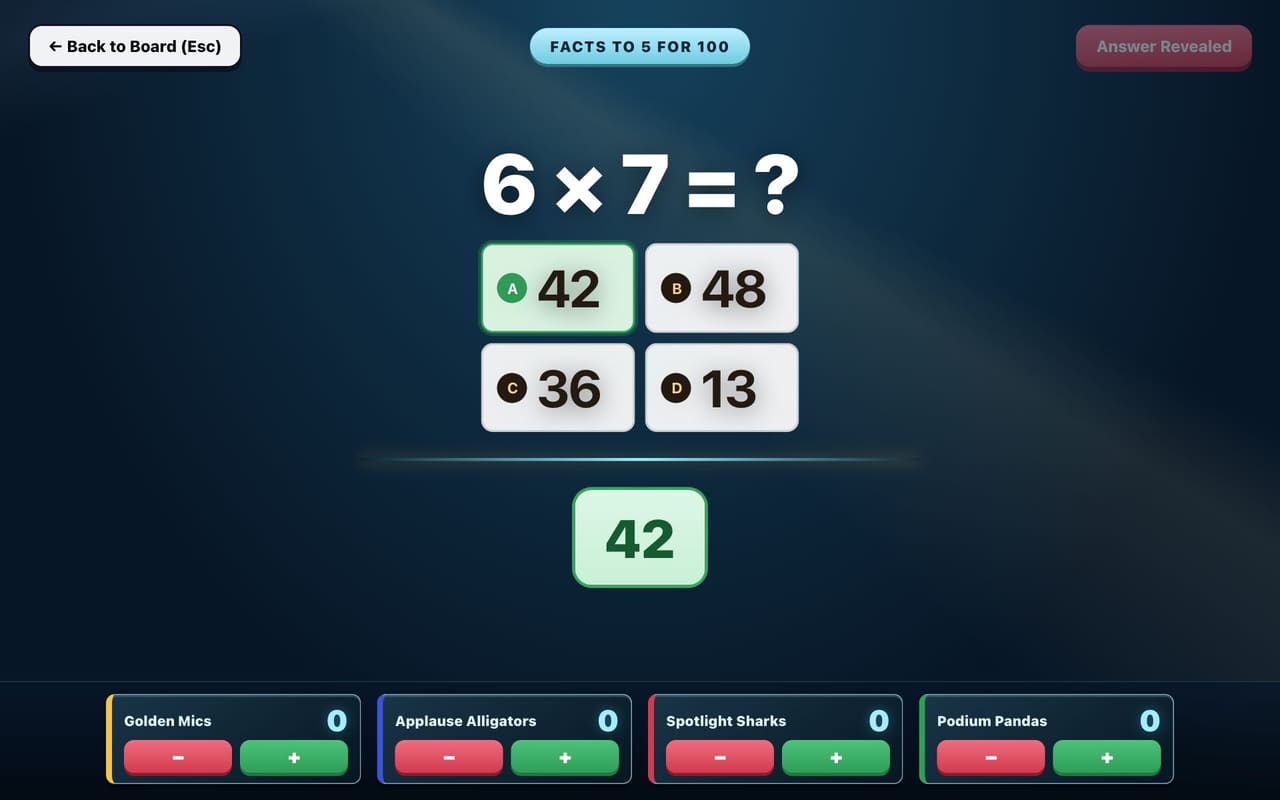
Tap a cell and the question fills the screen. Press Reveal Answer (or the spacebar), tap + on every team that earned it, and Esc back to the board. Clear the board and Crown the Champions.
Science jeopardy questions, answered
Can I include diagrams such as a food web or a cell?
Questions on the quiz-show board are text, so describe the diagram or project it alongside the board. Many teachers put the figure on a slide and ask the board question about it.
How many questions fit?
Twenty-five fills a 5-by-5 board at 100 to 500. Smaller banks shrink the board; a bank of 40 rolls onto a second board you reach with Next Board.
Can the AI draft science questions for a specific unit?
Yes. Create with AI in My Question Banks takes a subject and grade plus a note such as 'plate tectonics, 6th grade, include boundary types' and drafts 5 to 20 questions you review before you play.