Why math works on a quiz-show board
Math is the subject the quiz-show format was made for. Every problem has one right answer, so the reveal is clean. Values let you grade difficulty honestly: a 100 is a fact, a 500 is a multi-step problem with a trap in it. And because teams work the same problem on whiteboards at the same time, nobody sits out while one student answers.
Category ideas for math jeopardy
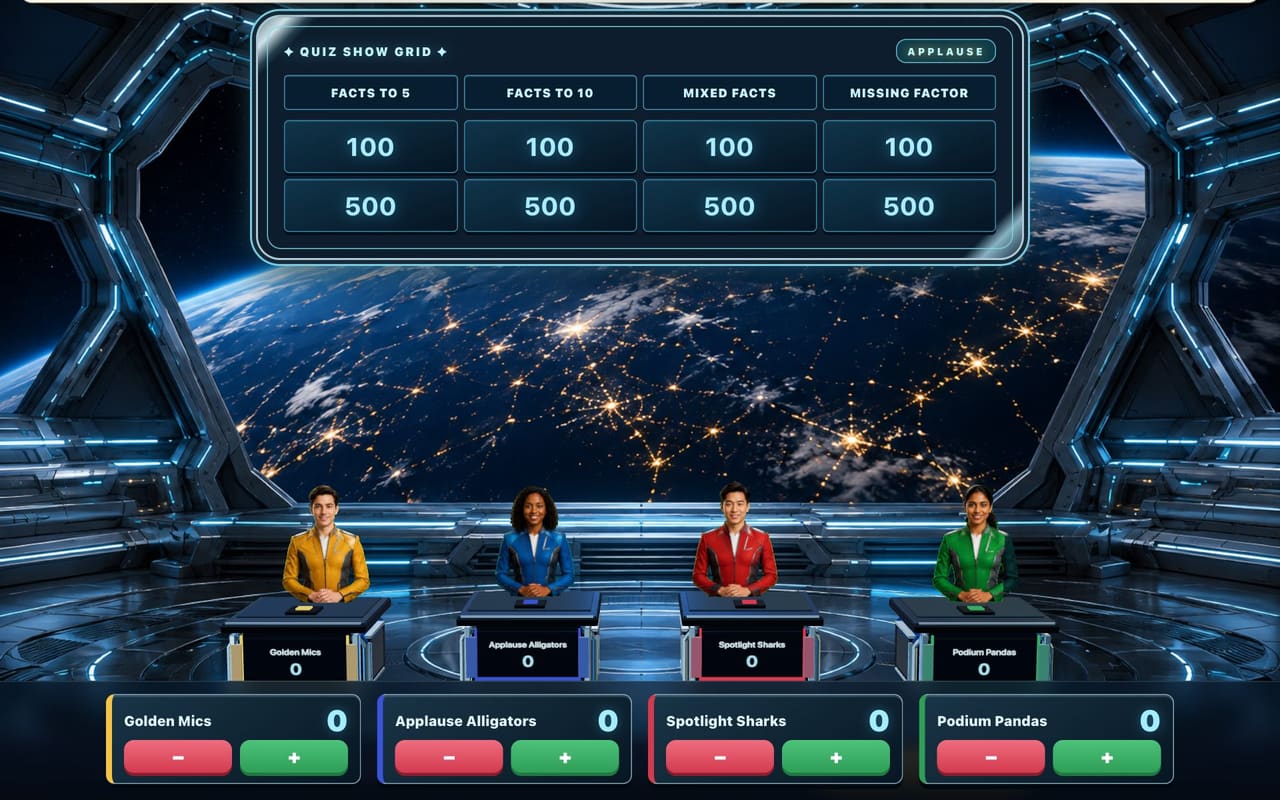
Five columns, five values each. Copy a set as it stands, or swap in the names of your own units. The board draws your categories in the order you type them.
Grade 5 operations and fractions
One column per operation keeps the board readable from the back row. The word-problem column pulls from all four, so save it for last when teams are warmed up.
Middle school pre-test review
Match the columns to the units on the test. A student who clears Ratios and Rates knows exactly which page of the study guide to reread.
Whole-year mixed review
Error Analysis shows a worked problem with one wrong step; teams name the step. Teacher's Choice is five questions you most want to see again before the test.
How to mix difficulty from 100 to 500
The value is a promise to the class about how hard the question is. Keep the promise and teams will reach for the 500s.
- 100One step, one fact7 × 8, or name the place value of the 4 in 3,412.
- 200Procedure, no twistAdd two fractions with unlike denominators, or simplify 3(x + 4).
- 300Procedure with a decisionWhich operation does this word problem need, and what is the answer?
- 400Two stepsFind the area of a composite figure, or solve 2x − 5 = 11 and check it.
- 500Explain or catch the errorHere is a student's work with one mistake. Name the step and give the correct answer.
Running math jeopardy with teams
Quiz Show Grid runs 2 to 8 teams from one screen, with a scorecard for each. These four rules keep every team working every question.
- 1
Every team works every problem. Give each team one whiteboard and one marker, rotate the writer each question, and award points to any team that has the right answer up when you reveal. The choosing team gets the pick, not a monopoly.
- 2
Require the work, not just the answer, on anything worth 300 or more. A correct answer with no work shown is a 100 regardless of the cell.
- 3
Say the math out loud after the reveal. Ask the winning team how they got it, in one sentence, before the next pick. That sentence is the review.
- 4
Use the minus button sparingly and announce the rule up front: a wrong answer only costs points on 400 and 500 cells. It keeps bold guessing alive without punishing a team into silence.
Build the board in 3 steps
- 1
Pick or build a question bank
Open Quiz Show Grid and choose a bank from My Question Banks. No bank yet? Create with AI: pick the subject and grade, add a note about the topic, and it drafts 5 to 20 questions you edit before you play.
- 2
Set teams and categories
Choose 2 to 8 teams and name them, or let the game pick names. Type your category names, comma separated. Up to 25 questions fill one board at 100 to 500 points; a bigger bank adds a second board.
- 3
Start the show
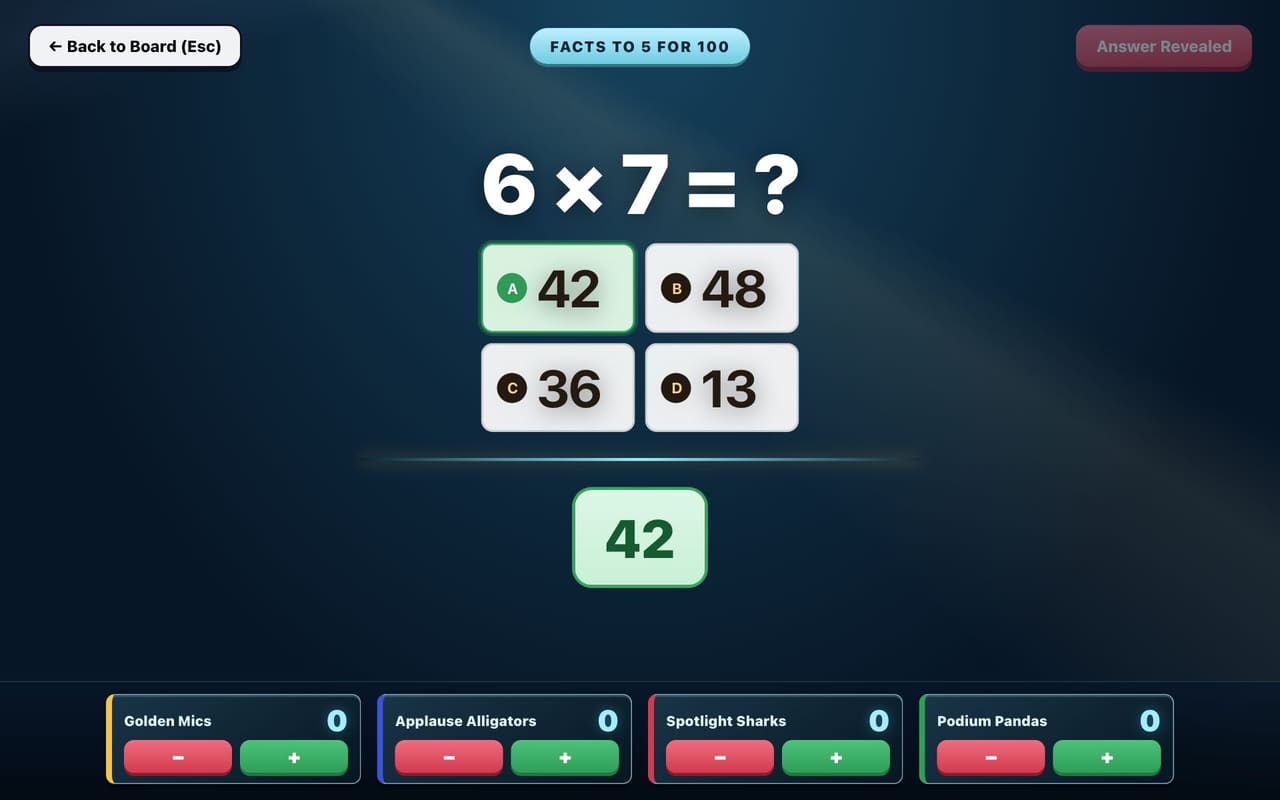
Tap a cell and the question fills the screen. Press Reveal Answer (or the spacebar), tap + on every team that earned it, and Esc back to the board. Clear the board and Crown the Champions.
Math jeopardy questions, answered
How many math questions do I need for a full board?
Twenty-five fills a 5-by-5 board at 100 to 500 points. Fewer still works: the board shrinks to fit, so 15 questions gives three rows. More than 25 rolls onto a second board you reach with Next Board.
Can students type answers, or is this whole-class only?
Quiz Show Grid is a projector game run by the teacher. Students answer on whiteboards or out loud and you award the points. If you want every student answering on their own device, the same question bank also plays in the Arcade games.
Can the AI write my math questions?
Yes. In My Question Banks, pick Create with AI, choose the subject and grade, add a note about the topic, and it drafts 5 to 20 questions for you to review and edit before you play.