
Why geometry works on a quiz-show board
Geometry mixes two kinds of knowing: facts you recall (the angle sum of a triangle) and reasoning you perform (why these two triangles are congruent). A quiz-show board lets you price them differently. Facts go in the 100 and 200 rows. Reasoning lives in the 400s and 500s where a team has to talk before it answers.
Category ideas for geometry jeopardy
Five columns, five values each. Copy a set as it stands, or swap in the names of your own units. The board draws your categories in the order you type them.
Middle school measurement
Name That Shape is the warm-up column. Transformations works well as describe-it-in-words: a team says 'reflect over the y-axis' and you reveal the coordinates to check.
High school geometry midterm
Which Theorem? gives a diagram description and asks for the name of the rule that solves it. It is the column that separates students who can compute from students who can choose.
Circles and solids
Keep Real World as the problems with units and rounding instructions. It is the column where a correct number with the wrong unit should cost a team the points.
How to mix difficulty from 100 to 500
The value is a promise to the class about how hard the question is. Keep the promise and teams will reach for the 500s.
- 100RecallHow many degrees in a straight angle? What is a polygon with six sides called?
- 200One formulaFind the area of a rectangle 7 by 12. Find the third angle if two are 40° and 65°.
- 300Choose the formulaFind the area of a triangle with base 10 and height 6, or the circumference of a circle with radius 4.
- 400Two formulas or a compositeFind the area of an L-shaped figure, or the hypotenuse then the perimeter.
- 500JustifyAre these triangles congruent? Name the postulate, or explain why there is not enough information.
Running geometry jeopardy with teams
Quiz Show Grid runs 2 to 8 teams from one screen, with a scorecard for each. These four rules keep every team working every question.
- 1
Give every team a whiteboard and a ruler or a sheet of grid paper. Geometry answers are faster to show than to say, and a quick sketch settles arguments about what the question meant.
- 2
Read the diagram description twice. Questions on the board are text, so the second reading is where teams catch 'radius' versus 'diameter'.
- 3
Require units on anything worth 300 or more, and announce it before the first pick. 'Forty-eight' is not an area. 'Forty-eight square centimeters' is.
- 4
Let the choosing team pick, but let any team with the correct work up at the reveal collect the points. Geometry teams otherwise learn to pick only the columns they like.
Build the board in 3 steps
- 1
Pick or build a question bank
Open Quiz Show Grid and choose a bank from My Question Banks. No bank yet? Create with AI: pick the subject and grade, add a note about the topic, and it drafts 5 to 20 questions you edit before you play.
- 2
Set teams and categories
Choose 2 to 8 teams and name them, or let the game pick names. Type your category names, comma separated. Up to 25 questions fill one board at 100 to 500 points; a bigger bank adds a second board.
- 3
Start the show
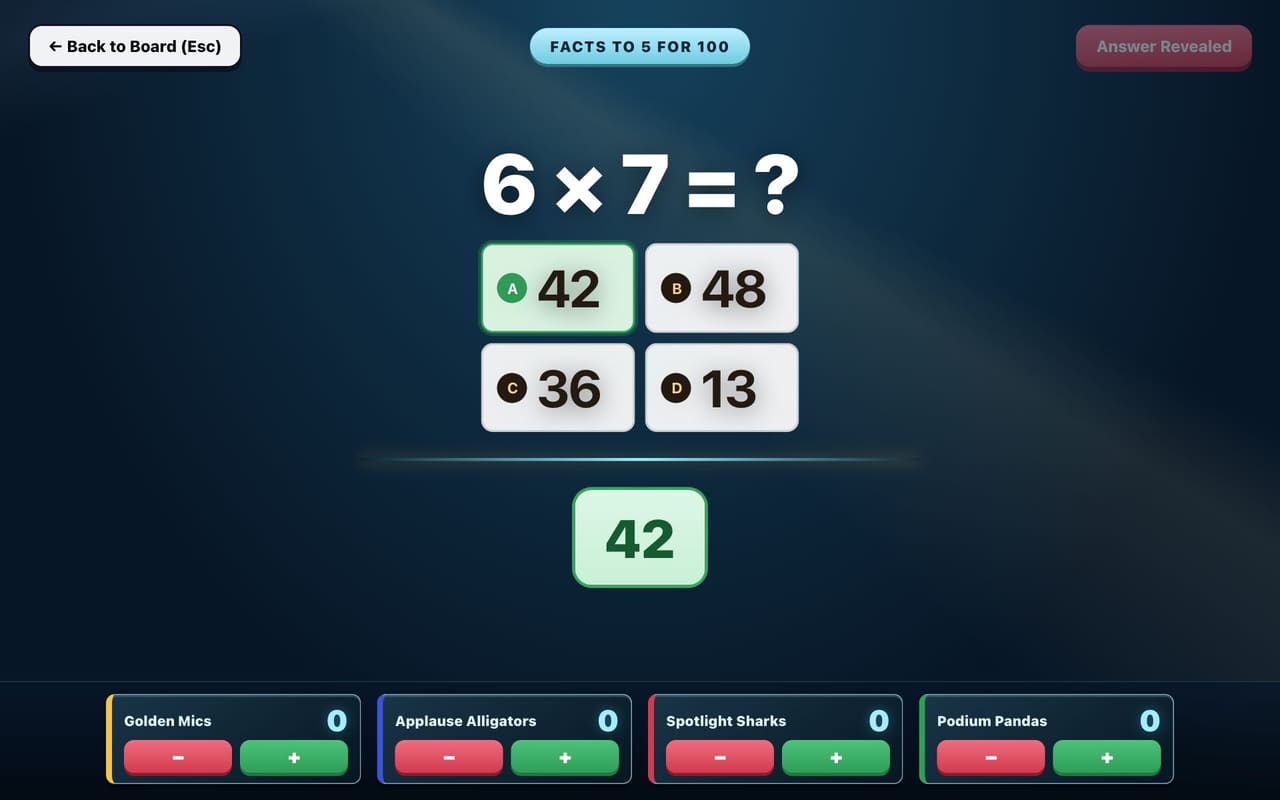
Tap a cell and the question fills the screen. Press Reveal Answer (or the spacebar), tap + on every team that earned it, and Esc back to the board. Clear the board and Crown the Champions.
Geometry jeopardy questions, answered
Can the board show diagrams?
Questions on the quiz-show board are text, so describe the figure in words and have teams sketch it, or project the diagram on a slide beside the board and ask the question from the cell.
How should I split the five categories across a unit?
Use four columns for the four biggest skills in the unit and keep the fifth for vocabulary or Which Theorem. The board draws your categories in the order you type them, so put the warm-up column first.
What if I only have 15 questions?
The board sizes itself to the bank. Fifteen questions give three rows at 100, 300 and 500 points. You can add more questions with the AI builder before you play.