
Why algebra works on a quiz-show board
Algebra problems have more steps than arithmetic, so the board's value ladder matters more here than in any other subject. A 100 should take fifteen seconds. A 500 should need the whiteboard. If every cell takes three minutes the game stalls, and if every cell is a one-liner the strong students coast.
Category ideas for algebra jeopardy
Five columns, five values each. Copy a set as it stands, or swap in the names of your own units. The board draws your categories in the order you type them.
Linear equations unit
Each column is a stage of the unit, so clearing the board walks the class from one-step equations back to writing equations from a graph or a table.
Semester review
Systems and Word Problems eat the most time. Put only three questions in those columns if your period is short; the board fits uneven columns.
Functions and exponents
Function or Not? is pure yes-or-no with a reason, so it is a fast column to open the game. Spot the Error closes it: a worked solution with one wrong line.
How to mix difficulty from 100 to 500
The value is a promise to the class about how hard the question is. Keep the promise and teams will reach for the 500s.
- 100Vocabulary or one operationWhat is the coefficient in 7x − 3? Solve x + 9 = 14.
- 200A standard two-stepSolve 3x − 4 = 17. Simplify 2(x + 5) − 3x.
- 300Choose the methodSolve 5x + 2 = 2x + 11. Find the slope between (1, 4) and (3, 10).
- 400Translate first, then solveA gym charges $20 to join and $8 a month. Write the equation and find the cost after 6 months.
- 500Multi-part or justifySolve the system by any method and show it checks in both equations.
Running algebra jeopardy with teams
Quiz Show Grid runs 2 to 8 teams from one screen, with a scorecard for each. These four rules keep every team working every question.
- 1
Whiteboards for every team, every problem. Algebra is where the choosing team does the work and four other teams watch, unless you make simultaneous answering the rule from the first cell.
- 2
Show the work for 300 and up. Announce it before the game: a bare answer on a 400 earns 100. Students stop skipping steps when the steps are worth money.
- 3
After each reveal, ask one team to name the first step out loud. Not the answer, the first step. That is the habit the test rewards.
- 4
Keep teams to four students. In algebra, a team of six becomes two workers and four spectators. Quiz Show Grid runs up to eight teams, so split a large class rather than enlarge the teams.
Build the board in 3 steps
- 1
Pick or build a question bank
Open Quiz Show Grid and choose a bank from My Question Banks. No bank yet? Create with AI: pick the subject and grade, add a note about the topic, and it drafts 5 to 20 questions you edit before you play.
- 2
Set teams and categories
Choose 2 to 8 teams and name them, or let the game pick names. Type your category names, comma separated. Up to 25 questions fill one board at 100 to 500 points; a bigger bank adds a second board.
- 3
Start the show
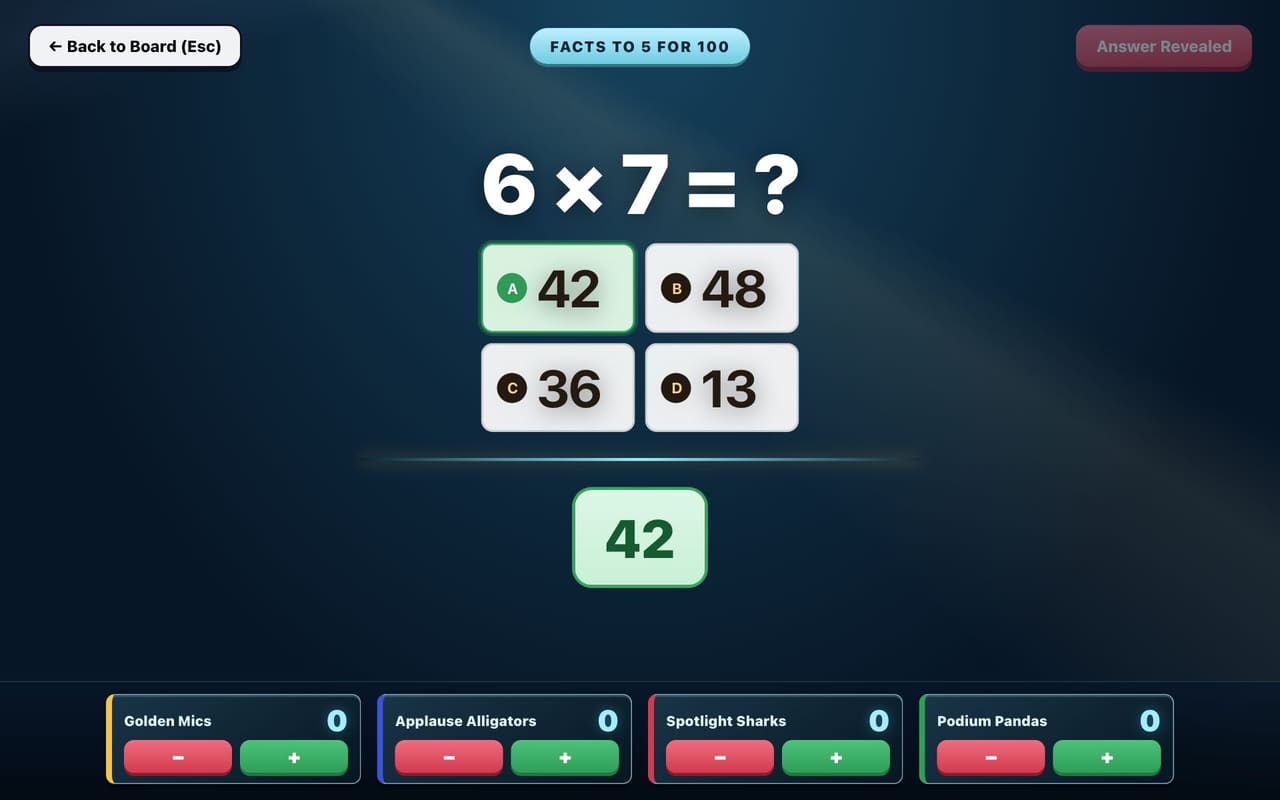
Tap a cell and the question fills the screen. Press Reveal Answer (or the spacebar), tap + on every team that earned it, and Esc back to the board. Clear the board and Crown the Champions.
Algebra jeopardy questions, answered
Can I show equations and graphs on the board?
Questions on the quiz-show board are text, so write equations the way you would type them (3x + 2 = 11) and describe a graph in words for a whiteboard response, or project the graph on a slide beside the board.
How long does an algebra board take?
Plan on 25 to 40 minutes for 25 cells with four teams if you require work on the higher values. For a 45-minute period, load 20 questions and the board shrinks to four rows.
Does the game keep score for me?
Yes. Each team has a scorecard with plus and minus buttons for the cell's value. Undo Last reverses a mistaken award, and Crown the Champions shows the final podium.