Why world history works on a quiz-show board
The best world history boards are organized by theme across places rather than by place alone. A column called Trade Routes can hold the Silk Road, the Indian Ocean network and the trans-Saharan caravans in the same five cells, and a team that clears it has compared three regions without being told to. The value ladder then prices the climb from name the route to explain what moved along it and what changed because of it.
Category ideas for world history jeopardy
Five columns, five values each. Copy a set as it stands, or swap in the names of your own units. The board draws your categories in the order you type them.
Ancient civilizations
Compare Two gives a pair, Athens and Sparta or Egypt and Mesopotamia, and asks for one similarity and one difference. It is the 500 column by nature.
Thematic review
Empires Fall is where cause-and-effect lives. Ask for two causes of a collapse, and award the cell only when the team gives a reason, not just a name.
Modern era
Primary Sources quotes a short line and asks for the movement or the author. Keep each quote to one sentence so it reads from the back of the room.
How to mix difficulty from 100 to 500
The value is a promise to the class about how hard the question is. Keep the promise and teams will reach for the 500s.
- 100Name itWhich river did ancient Egypt depend on? Who was the first emperor of a unified China?
- 200Place itOn which continent was the Mali Empire? In which century did the Black Death reach Europe?
- 300Match or sequencePut these empires in order of rise: Roman, Mongol, Ottoman, Persian.
- 400Explain one causeName one reason the Silk Road declined and explain it in a sentence.
- 500Compare and judgeCompare how the Roman and Han empires fell. Name one shared cause and one difference.
Running world history jeopardy with teams
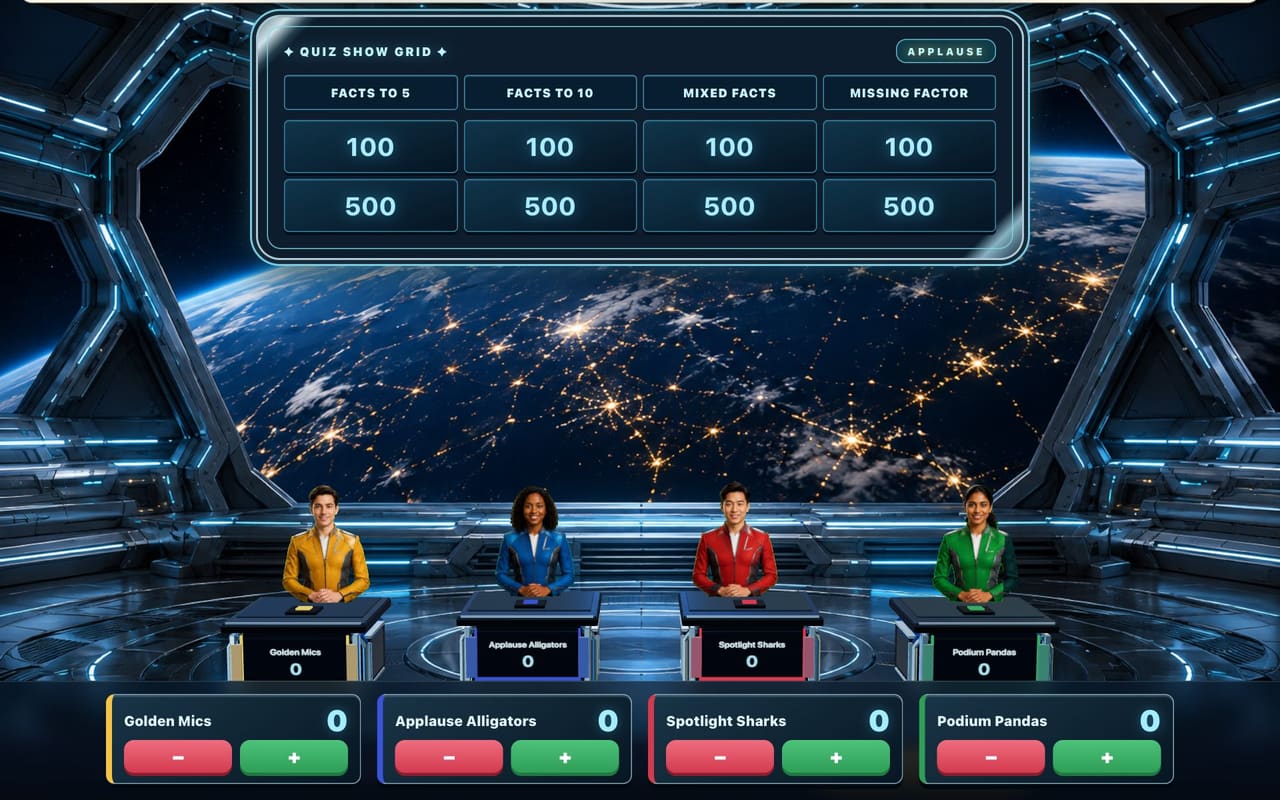
Quiz Show Grid runs 2 to 8 teams from one screen, with a scorecard for each. These four rules keep every team working every question.
- 1
Whiteboards for every team, every cell. World history teams split naturally into one talker and three listeners unless writing is required.
- 2
Score reasons on the top two rows. A team that names a cause and explains it earns the cell; a team that only names it earns 100.
- 3
Hand each team a blank world map at the start. Place-it questions are answered by pointing on the map and holding it up, which is faster than spelling.
- 4
Put the Compare Two or Compare and Judge column last. It needs the whole board in students' heads and it is where the game is decided.
Build the board in 3 steps
- 1
Pick or build a question bank
Open Quiz Show Grid and choose a bank from My Question Banks. No bank yet? Create with AI: pick the subject and grade, add a note about the topic, and it drafts 5 to 20 questions you edit before you play.
- 2
Set teams and categories
Choose 2 to 8 teams and name them, or let the game pick names. Type your category names, comma separated. Up to 25 questions fill one board at 100 to 500 points; a bigger bank adds a second board.
- 3
Start the show
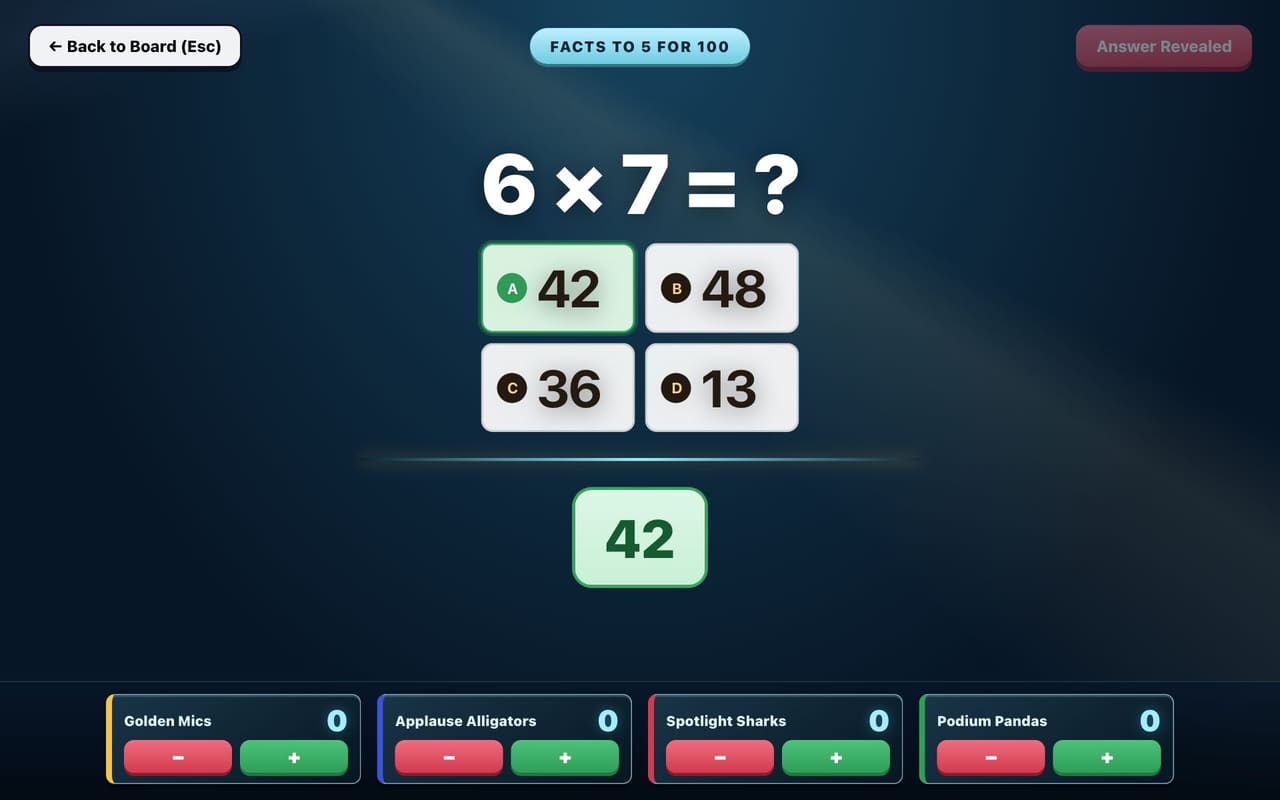
Tap a cell and the question fills the screen. Press Reveal Answer (or the spacebar), tap + on every team that earned it, and Esc back to the board. Clear the board and Crown the Champions.
World history jeopardy questions, answered
How do I fit a semester into 25 cells?
You do not have to. Build one bank per unit, 15 to 25 questions each, and run them as separate boards. For the final, load a 50-question bank and the game chains two boards with Next Board.
Can questions include maps or images?
Board questions are text. Describe the map or project it on a slide beside the board, and have teams answer on whiteboards or a printed outline map.
Can the AI help me write questions on a specific civilization?
Yes. Create with AI takes a subject and grade plus a note such as 'Mongol Empire, 7th grade, include trade and succession' and drafts 5 to 20 questions you edit before playing.