Why spelling works on a quiz-show board
A spelling list is really a set of patterns, and a five-column board lets you name them: silent letters, double consonants, vowel teams, plurals, homophones. When a team clears the Silent Letters column, they have practiced the pattern five times, from the easiest word to the hardest, and the next column is a different pattern. That beats a random list read aloud.
Category ideas for spelling jeopardy
Five columns, five values each. Copy a set as it stands, or swap in the names of your own units. The board draws your categories in the order you type them.
Pattern board (grades 2 to 4)
Order the words in each column from shortest to longest so the 100 to 500 ladder is honest. Sight Words is the column that keeps a struggling team in the game.
Rules board (grades 4 to 6)
Homophones needs a sentence with every word: 'their coats are by the door'. Tricky Words is the list every teacher keeps: separate, definitely, necessary, rhythm.
Content words
Content words count. Students who can spell 'denominator' and 'photosynthesis' read them faster in the textbook. Our Community is local names: the school, the town, the state.
How to mix difficulty from 100 to 500
The value is a promise to the class about how hard the question is. Keep the promise and teams will reach for the 500s.
- 100Short and regularrain, hop, cats
- 200One patterntrain, hopping, boxes
- 300Pattern plus a twistneighbor, beginning, knives
- 400Multi-syllabletemperature, separate, government
- 500The hard one, or the ruleconscience, or: spell 'receive' and name the rule.
Running spelling jeopardy with teams
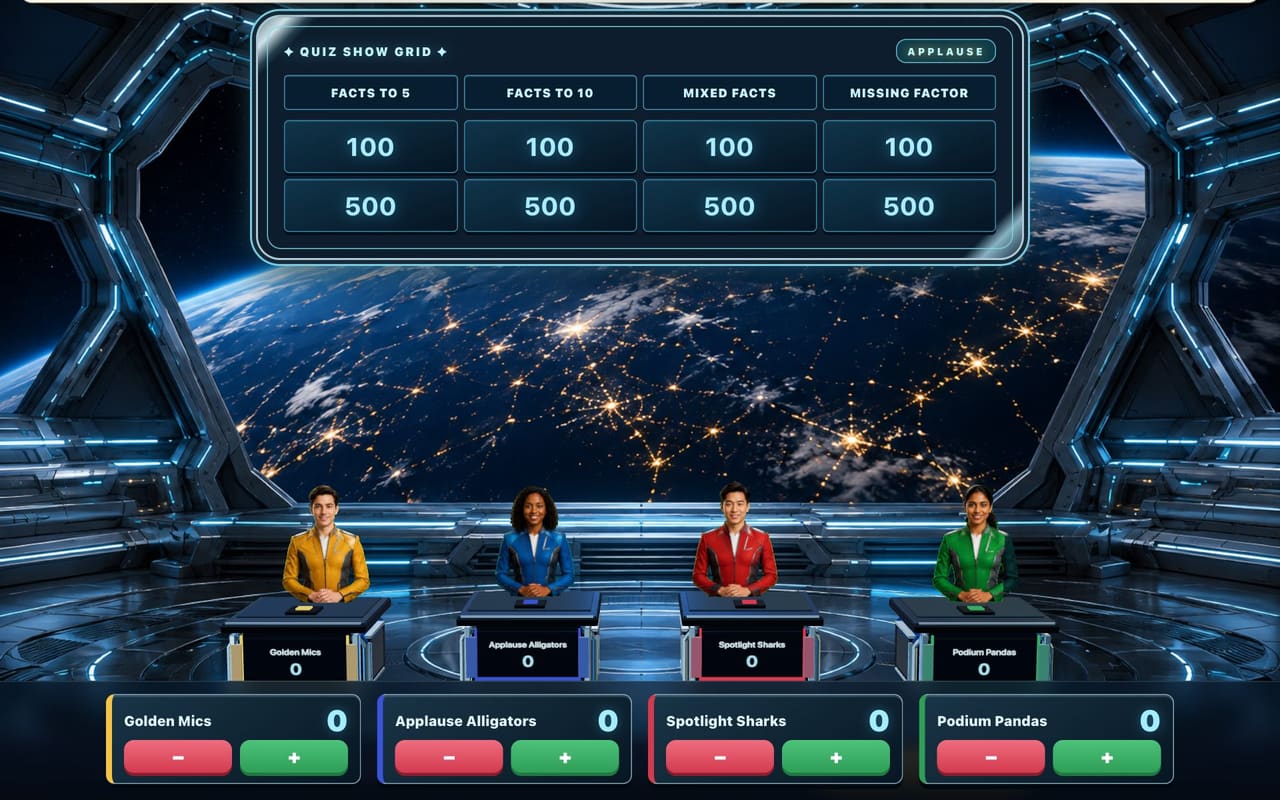
Quiz Show Grid runs 2 to 8 teams from one screen, with a scorecard for each. These four rules keep every team working every question.
- 1
Say the word, use it in a sentence, say the word again. Then every team writes it. Reveal the answer on the board and every team with it right earns the points.
- 2
The choosing team picks the cell; it does not get a head start. Say the word only after every team has a marker up.
- 3
Rotate the writer every cell, no exceptions. The student who most needs to spell the word is the one most likely to pass the marker.
- 4
On 400 and 500 cells, ask the winning team to say the word in syllables after the reveal. That is the strategy you want the rest of the class to steal.
Build the board in 3 steps
- 1
Pick or build a question bank
Open Quiz Show Grid and choose a bank from My Question Banks. No bank yet? Create with AI: pick the subject and grade, add a note about the topic, and it drafts 5 to 20 questions you edit before you play.
- 2
Set teams and categories
Choose 2 to 8 teams and name them, or let the game pick names. Type your category names, comma separated. Up to 25 questions fill one board at 100 to 500 points; a bigger bank adds a second board.
- 3
Start the show
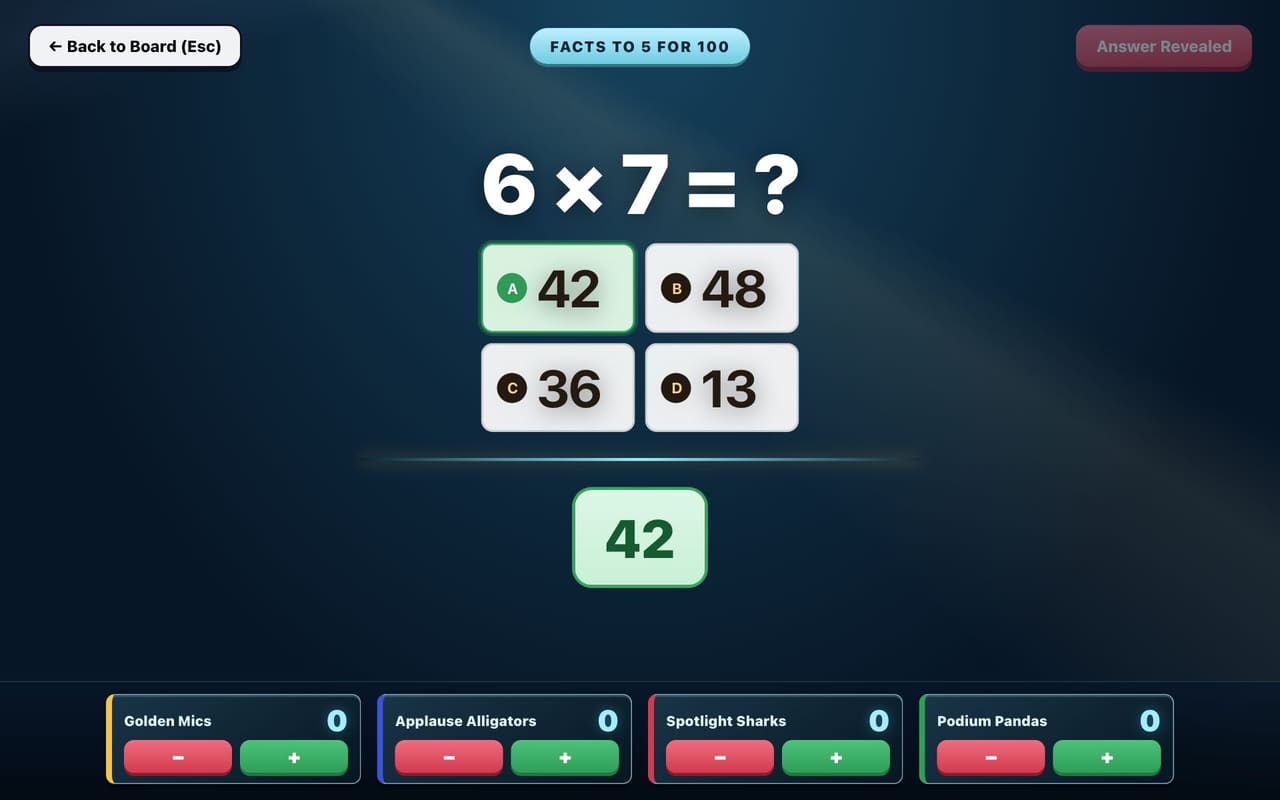
Tap a cell and the question fills the screen. Press Reveal Answer (or the spacebar), tap + on every team that earned it, and Esc back to the board. Clear the board and Crown the Champions.
Spelling jeopardy questions, answered
The word is in the question. Won't students see it?
Put the sentence or a clue in the question, not the word. Write 'Spell the word that means a large body of salt water' or 'Spell: the opposite of early', and put the word itself in the answer, which shows on reveal.
How many words fit on a board?
Twenty-five fills a 5-by-5 board. A 15-word list gives three rows, which is right for a Thursday review before a Friday test.
Can students practice the same list on their own?
Yes. The same question bank runs the Arcade games, where each student plays alone on a device.