Why grammar works on a quiz-show board
Grammar is the subject where the gap between knowing the rule and using it is widest, and the value ladder is built for that gap. Identification lives at 100 and 200. Choosing the correct form lives at 300. Finding and fixing an error lives at 400 and 500, where the team writes a new sentence and the class judges it. Students see the climb and learn that naming a comma splice is not the same as fixing one.
Category ideas for grammar jeopardy
Five columns, five values each. Copy a set as it stands, or swap in the names of your own units. The board draws your categories in the order you type them.
Parts of speech and sentences
Fix It is a sentence with one error. Teams rewrite it; several correct fixes may exist, so award every team with a valid repair.
Punctuation and usage
Homophones is the fast column (their, there, they're). Run-ons and Fragments scales from 'is this a fragment' at 100 to 'rewrite this run-on three ways' at 500.
Agreement and clarity
A middle and high school board. Make It Clearer gives a correct but clumsy sentence and asks for a tighter version; the class votes on the best rewrite.
How to mix difficulty from 100 to 500
The value is a promise to the class about how hard the question is. Keep the promise and teams will reach for the 500s.
- 100IdentifyWhich word is the verb in 'The dog chased the ball'?
- 200Choose the formThe team (is / are) winning. Which is correct?
- 300Find the errorWhich word in this sentence is wrong, and why?
- 400Fix the errorRewrite the sentence so the modifier describes the right thing.
- 500Rewrite and explainCombine these three short sentences into one clear sentence and name the structure you used.
Running grammar jeopardy with teams
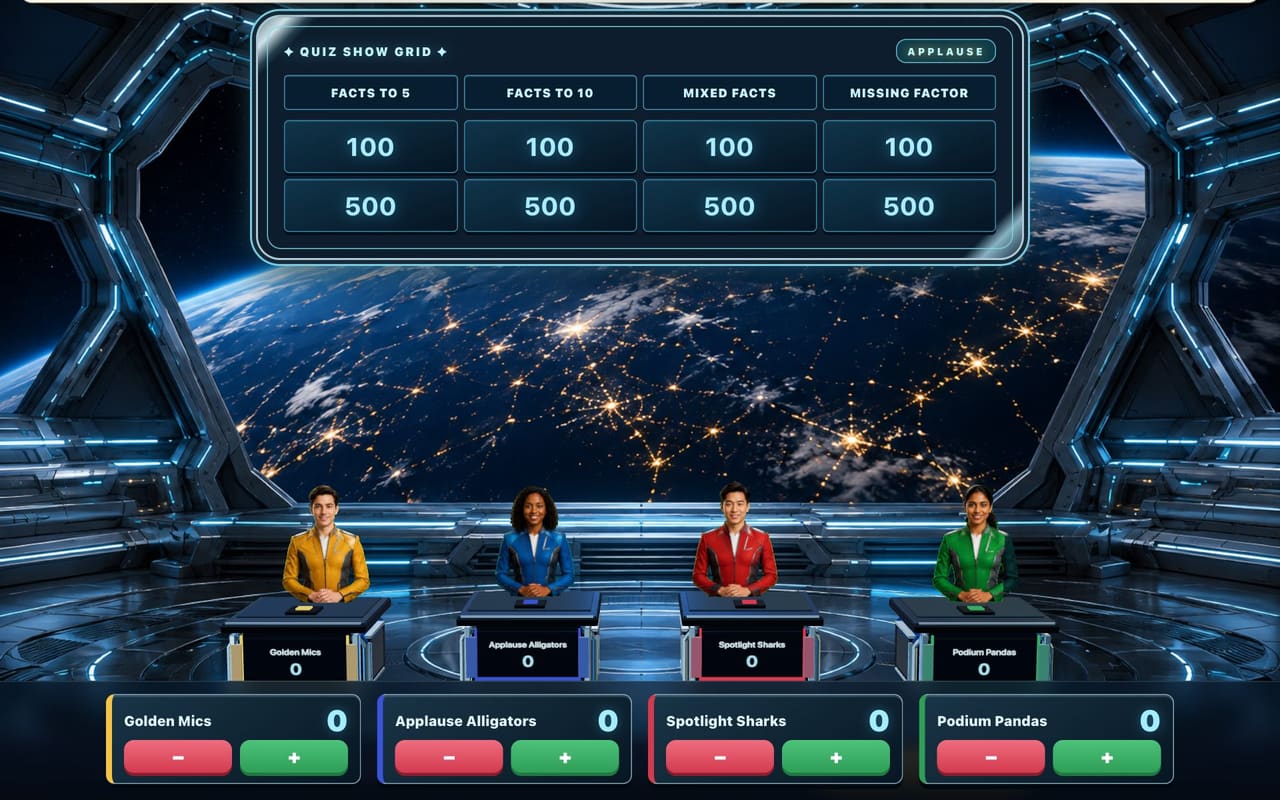
Quiz Show Grid runs 2 to 8 teams from one screen, with a scorecard for each. These four rules keep every team working every question.
- 1
Whiteboards for every team, every cell. Grammar answers are sentences, and sentences need to be written to be judged.
- 2
On Fix It cells, award the points to every team whose rewrite is correct, then ask the class which fix reads best. The second question teaches more than the first.
- 3
Read the sentence aloud exactly as written, errors included. Hearing the run-on is often what helps a team find it.
- 4
Give a 100-point bonus to any team that catches an error you did not plant. It happens, and it keeps everyone reading closely.
Build the board in 3 steps
- 1
Pick or build a question bank
Open Quiz Show Grid and choose a bank from My Question Banks. No bank yet? Create with AI: pick the subject and grade, add a note about the topic, and it drafts 5 to 20 questions you edit before you play.
- 2
Set teams and categories
Choose 2 to 8 teams and name them, or let the game pick names. Type your category names, comma separated. Up to 25 questions fill one board at 100 to 500 points; a bigger bank adds a second board.
- 3
Start the show
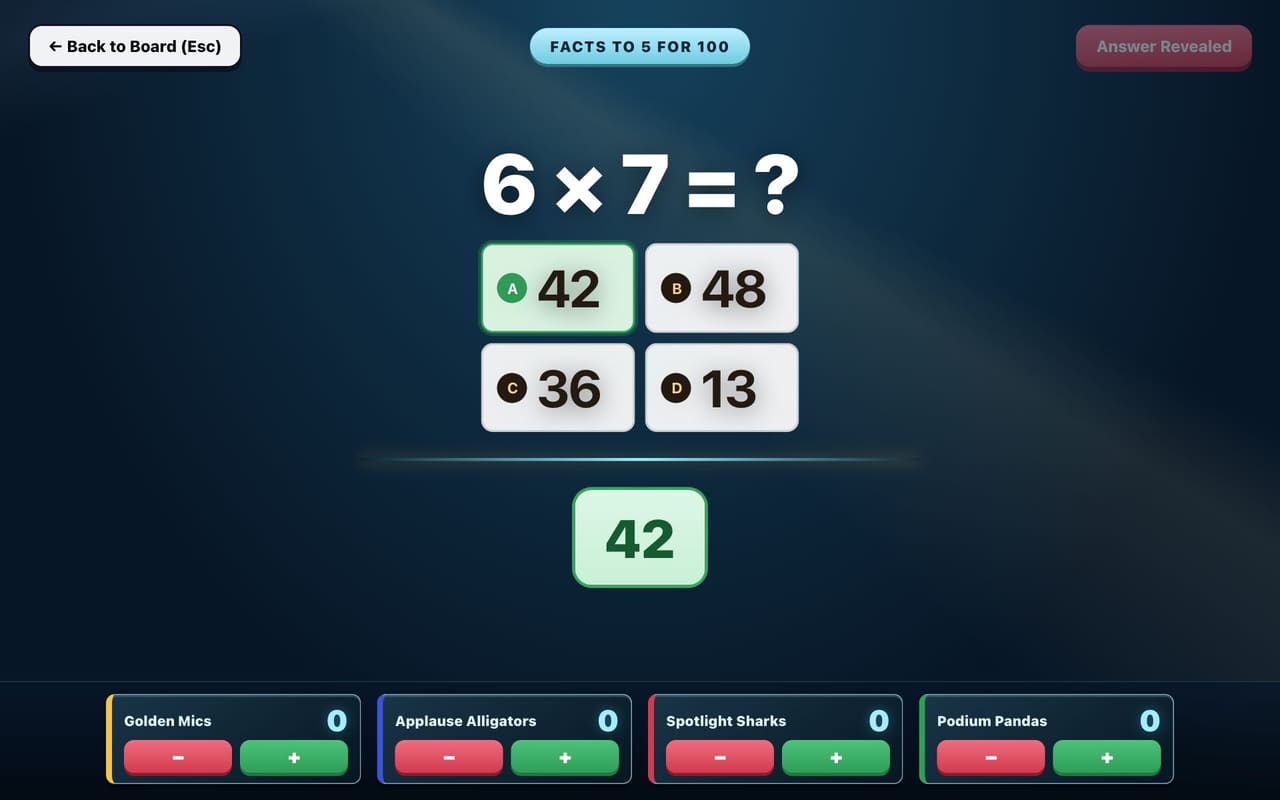
Tap a cell and the question fills the screen. Press Reveal Answer (or the spacebar), tap + on every team that earned it, and Esc back to the board. Clear the board and Crown the Champions.
Grammar jeopardy questions, answered
How do I show an error on the board without giving it away?
Write the sentence plainly in the question text with no underline or hint. Put the correct version in the answer, and the reveal shows the fix.
Can a cell have more than one correct answer?
Yes, and many grammar cells do. You award the points, so accept every valid rewrite. Write 'one correct version' in the answer so the reveal shows an example, not the only answer.
How many teams can play?
Two to eight. For grammar, four teams of four or five students keeps everyone writing. Larger classes play better as eight small teams than four large ones.